

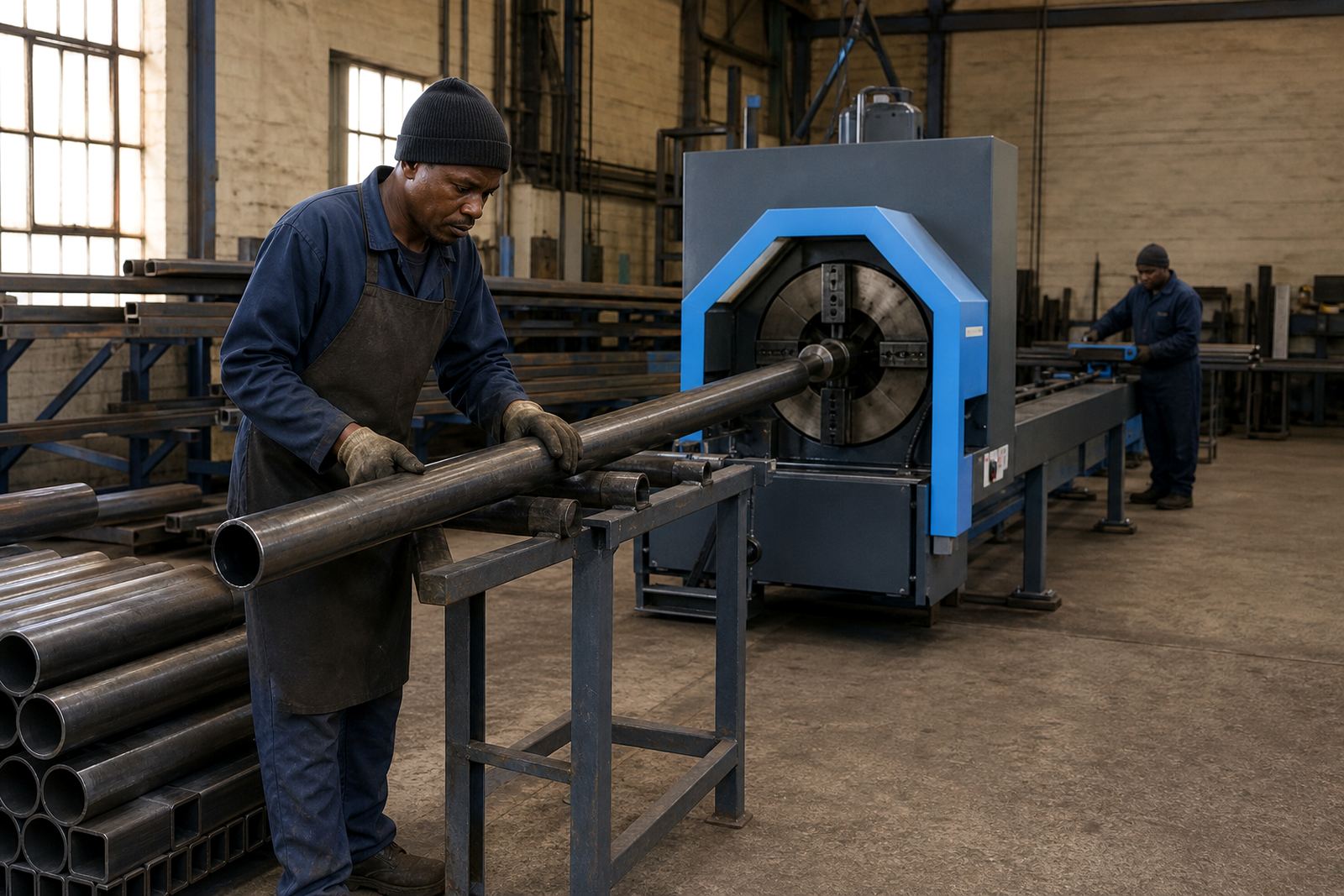
Where the story began in Wadeville
The first conversations were with fabricators who needed cleaner cuts, tighter fit-up and less hand finishing on round tube, square tube, rectangular tube, angle and channel. That shaped the business from the start. The machines had to suit real workshops where floor space matters, operators change, and jobs move from one profile to the next without fuss.
Wadeville was a practical base for that work. It sits close to Johannesburg industry, transport routes and the kind of steel stockholders that keep fabrication moving. From there, the business learnt how South African customers think about equipment: not as a showroom purchase, but as a machine that has to fit a bay, a crew and a production schedule.
- Tube and profile cutting for mixed workshop work
- Support for round, square and rectangular sections
- Practical planning for loading, rigging and layout
Machines grew with the material on the floor
As customer jobs became more varied, the machine range had to keep pace. Tube cutting moved beyond basic straight cuts into bevel heads, tighter nest layouts and better control over corner quality on complex profiles. The conversation also widened to chucks, support systems and clamp settings, because the cutting result depends on how the tube is held as much as how the beam moves.
That growth came from listening to fabricators who know what happens when material is slightly out of round, when an angle section is twisted, or when a channel needs repeatable hole positions. The detail matters. A machine that can handle changing stock, short runs and longer production batches gives a shop more room to work without redoing every setting by hand.
- Chuck setup for different tube diameters and wall thicknesses
- Bevel cutting for weld prep and joint fit-up
- Nesting software for tighter material use and cleaner job sequencing
Customers shaped the way the team works
The customer base has never been one type of business. Some are small fabrication shops in Johannesburg or Pretoria taking in stair parts, frames and structural pieces. Others are larger operations in Durban, Cape Town or Gqeberha making repeat components that must fit into an established production flow. There are also clients in Bloemfontein, Nelspruit and nearby industrial areas who need equipment that can travel, install well and stay aligned.
That spread of customers pushed the team to think beyond the sale. Site Assessment, Delivery Rigging, Machine Installation, Commissioning and Operator Training all sit together because a laser tube machine is only as useful as the setup around it. Assist gas selection, nozzle condition, cut quality and feed habits all become part of the working routine.
- Small job shops needing flexible tube and profile cutting
- Production plants running steady batches and repeat parts
- Fabricators that want practical training on the machine floor
The people behind the machines
LaserTube today is built around a team with different strengths that fit the same trade. Michael Dlamini leads the business from the Wadeville base with a close eye on how machines are specified and supported. Anika Kajee handles sales conversations and keeps the commercial side grounded in what the workshop actually needs. Sibusiso Bhengu leads installation work, while Leanne Mabuza runs operator training and nesting training for crews that need steady, repeatable habits.
Pieter Visser handles service work and fault-finding, and Ayanda Mashaba supports applications where cutting parameters, material choice and job setup need careful attention. That mix matters because tube cutting jobs are not all alike. A crew working on mild steel sections has different questions from one handling thicker wall stock, mixed profiles or bevel work. The team works with those differences in a practical way, not by forcing every site into the same pattern.
- Installation and commissioning with the machine set for the job at hand
- Training that covers operators, nesting and daily checks
- Service support for alignment, calibration and breakdown response
Safety, gases and setup became part of the craft
As the work matured, the support around the machine became just as important as the cutting head itself. Assist gases have a direct effect on edge quality, dross and speed, so gas setup is handled with care. Safety is equally practical: guarding, interlocks, clean walkways, extraction where needed and a clear process for loading material all reduce avoidable trouble in a busy workshop.
The same applies to chuck alignment and bevel calibration. A machine can only perform to its level when the mechanical setup is right and the operator understands what to watch for. Preventive Maintenance and Remote Diagnostics help keep the equipment in service, while Breakdown Response and on-site checks deal with the issues that interrupt production. It is steady work, not glamorous work, but that is what keeps a fabrication line moving.
- Assist gas setup for cut quality and edge finish
- Chuck alignment and bevel calibration for accurate parts
- Preventive maintenance that supports day-to-day production
What the business looks like now
Today LaserTube supplies fibre laser tube and profile cutting machines to fabricators across South Africa, with the same base in Wadeville and the same focus on workshop reality. The machines serve round, square and rectangular tube, angle and channel, with features chosen to help shops move from setup work into production work without losing control of the cut.
The story is still tied to the same practical question that shaped the business at the start: what does a fabricator need on the floor to produce clean work with less waste and less guesswork? The answer sits in the combination of machine selection, installation, operator training, nesting training and ongoing service. That is the way the team works now, and the reason customers in industrial centres and regional towns alike keep the conversation grounded in the job, not the brochure.
- Base in Wadeville, Germiston serving sites across South Africa
- Machines for tube and profile cutting across multiple sectors
- Support that continues through installation, training and maintenance