Cape Town jobs that need more than a machine drop-off
Cape Town workshops work under a mix of coastal air, tight floor space and varied production runs, from small fabrication shops in industrial parks to larger plants feeding building, mining and transport work. The right setup starts with the tube sizes, wall thicknesses and cut profiles you actually run, then matching that to chuck capacity, loading method, nesting workflow and gas use.
For tube cutting, we cover round, square and rectangular sections, with profile cutting for angle and channel where the work calls for it. Where bevel cutting is needed for weld prep or joint fit-up, the head setup has to be checked carefully, because angle control and tube stability matter more than a glossy brochure claim.
Our Cape Town support starts with careful planning. That means looking at access for delivery rigging, floor loading, clearance around infeed and outfeed, and the operator flow needed to keep the machine productive without crowding the bay.
Cape Town areas we support
We work with metal fabricators in and around Cape Town, including industrial areas where stainless work, structural parts and general fabrication sit side by side. Some sites want a compact machine for shorter tube lengths and mixed jobs, while others need a production line arrangement with better material handling and repeatable loading.
- Site assessment for floor space, access and utility planning
- Delivery rigging for heavy machine sections and accessories
- Machine installation and commissioning on site
- Operator instruction for daily machine use and standard safety procedures
- Nesting training for material yield and job sequencing
- Preventive maintenance to keep alignment and motion under control
Coastal conditions also matter. Salt in the air can be hard on exposed metal parts, electrical panels and stored consumables if housekeeping slips, so we factor in protection, storage and routine checks for sites close to the harbour or along the peninsula.
Machine features that matter in local production
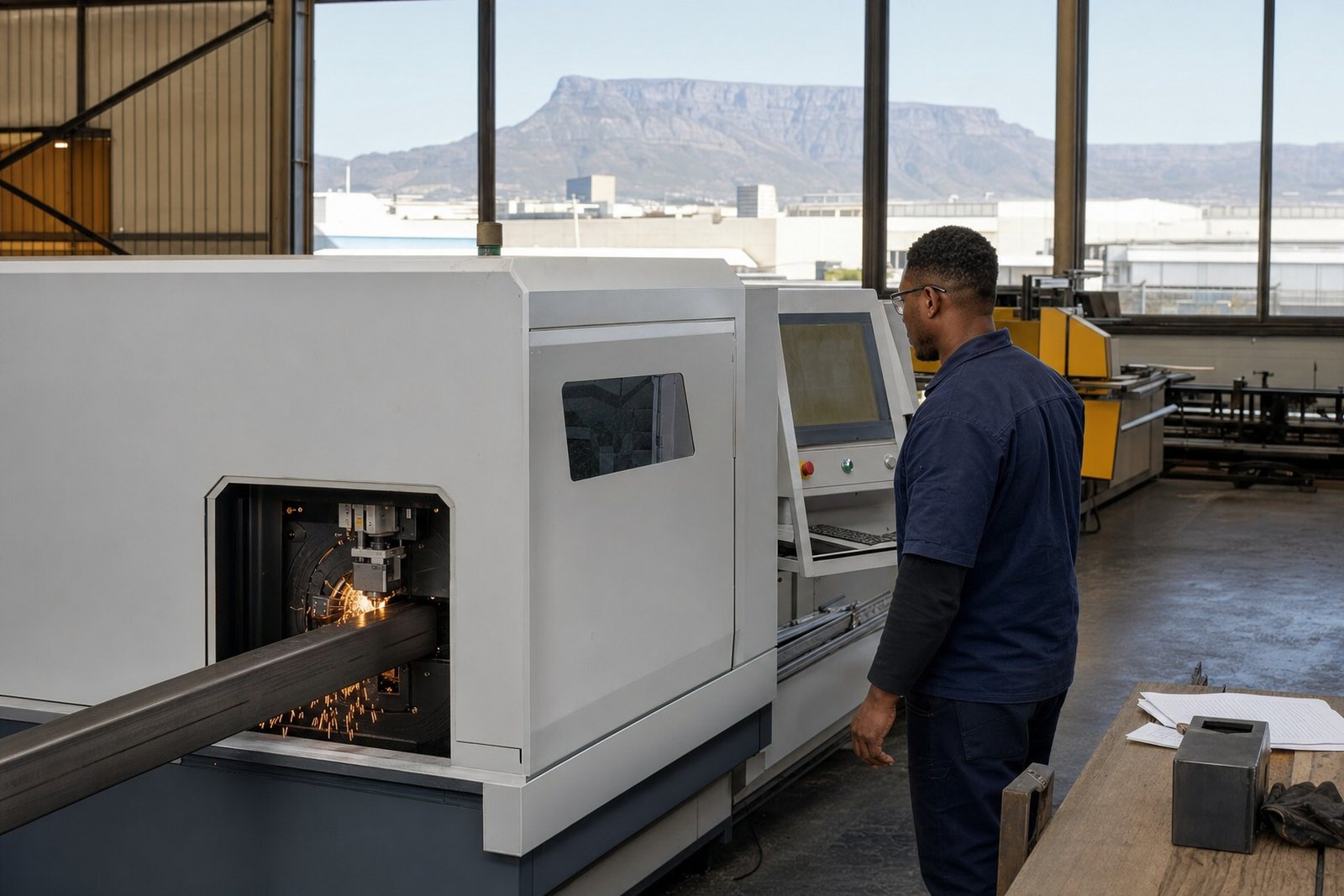
Tube and profile cutting in Cape Town often comes down to consistency over long shifts and mixed batches. A machine with proper chuck alignment, stable clamping and reliable nesting software helps reduce waste and keeps the cut path closer to what the drawing asks for. The machine still needs good operator discipline, especially where different wall thicknesses and profile shapes move through the same shift.
Assist gas setup is another area that deserves proper attention. Oxygen, nitrogen or air each has its place depending on material and finish requirements, and the gas setting affects edge quality, cutting speed and post-processing time. For aluminium, mild steel and stainless work, the right choice depends on the job spec and the finish expected by the next operation.
- Fibre laser source matched to the duty cycle and tube range
- Single or twin chuck handling for stable clamping and feed control
- Bevel head options where weld prep or joint geometry requires it
- Nesting software that supports efficient part layout and job repeatability
- Safety guarding, interlocks and extraction planning around the cutting bay
Installation and training from Wadeville into the Cape
Our base is in Wadeville, Germiston, and Cape Town installations are planned with transport, rigging and commissioning in mind before the machine leaves the floor in Gauteng. The job needs coordination from the first site walk through to the final checks on chuck alignment, beam path setup and cut quality on sample parts.
Training happens during the installation process so operators and supervisors can run the machine safely and consistently from the start. Operators need to understand load handling, nesting setup, edge condition checks, setting changes and basic fault finding, while supervisors often need a broader view of consumables, schedules and maintenance plans. For sites with multiple shifts, we also cover handover practice so the machine runs consistently from one operator to the next.
The training is built on the habits your own production floor uses. That includes loading safe lengths, checking tube straightness, confirming the profile orientation, and reading the cut result before a batch goes too far off spec.
Typical Cape Town clients and production work
Cape Town enquiries often come from metal fabricators who need one machine to handle a spread of work, from brackets and frames to structural tube, balustrade components and service parts. Larger manufacturers usually ask for a setup that can keep pace with recurring work, while smaller shops look for flexibility and a manageable footprint.
We also support businesses that work with subcontracted parts and short lead jobs, where a missed dimension or poor edge finish causes extra welding and rework. Tube laser cutting can help bring those jobs under tighter control, provided the machine, fixture setup and operator workflow are matched to the worklist.
Where the workshop needs service support, our team handles preventive maintenance, chuck alignment, bevel calibration, assist gas setup, remote diagnostics and breakdown response. Pieter Visser and Sibusiso Bhengu handle the practical side of those visits, while Leanne Mabuza covers operator and nesting training with the users on site.
Starting a Cape Town project
Cape Town project details can be sent on the contact form. Useful details include the tube and profile range, material types, expected shift pattern, available floor space and whether the site needs installation, training or maintenance support as part of the plan.
Michael Dlamini oversees the wider project flow with Anika Kajee on sales, Ayanda Mashaba on applications, and the service team on technical delivery. That structure helps us keep the setup practical for the site, whether the work is happening near Epping, Montague Gardens, Paarden Eiland or further out toward the industrial belt.
For Cape Town fabricators, the aim is a machine that fits the work, the space and the team using it. Correct tube handling, cutting settings and support keep the machine running smoothly in production and reduce stoppages, rework and pressure on the shop floor.