Angle section geometry needs a firmer hand
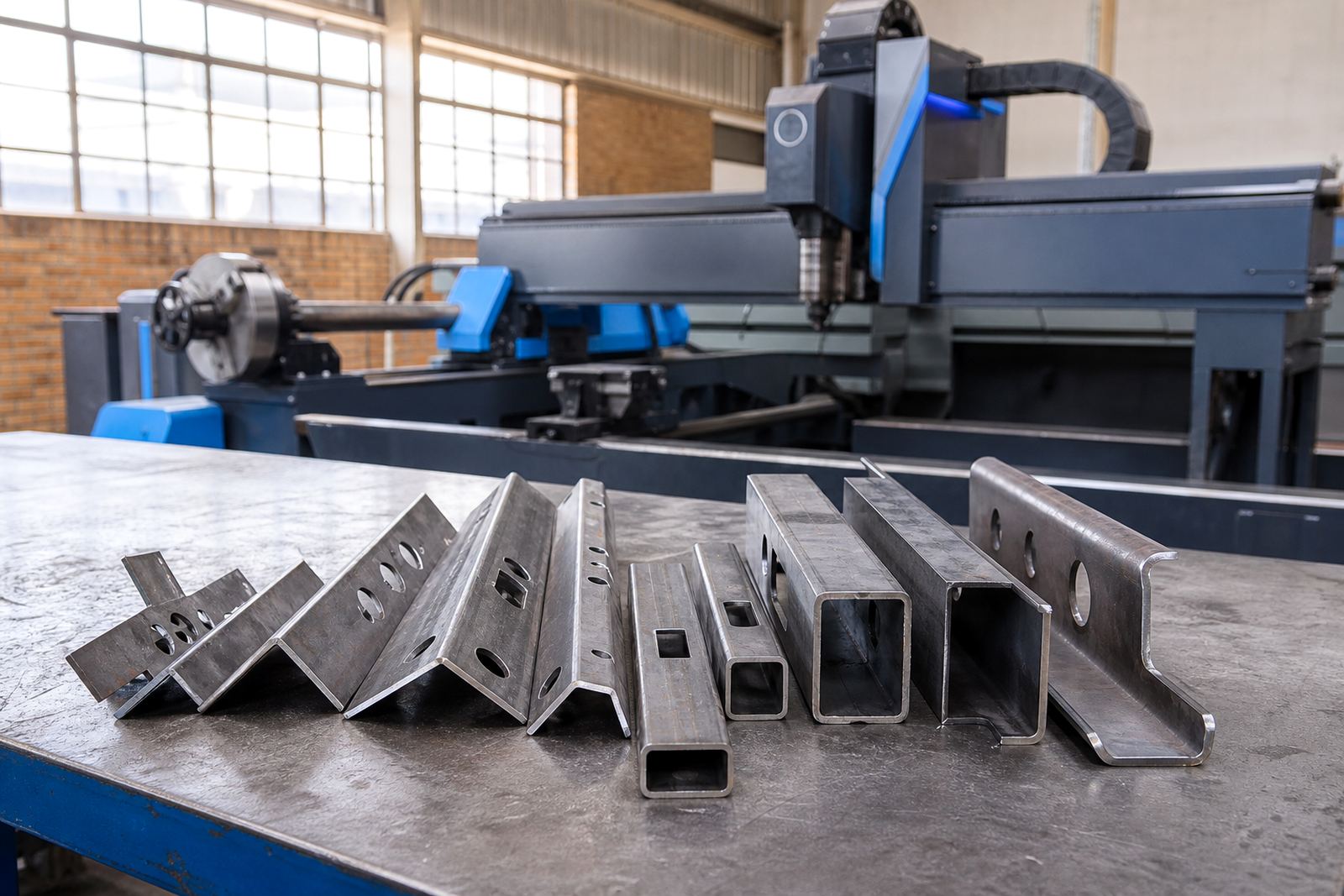
Angle iron carries more risk than a flat section because the two legs behave differently under clamp pressure and during rotation. A 50 x 50 x 5 mm angle does not present the same cutting face all the way through the machine, and a long length can try to lift or twist if support is uneven. That matters for straight cuts, mitres and any hole work near the heel or toe.
On a fibre laser tube and profile machine, the part is located by chucks and guided through the cutting zone while the head follows the programmed path. For angle, the setup has to keep the leg that is being cut clear of collision, while the other leg stays supported well enough to avoid chatter. If the stock moves, the cut moves with it.
Orientation decides the quality of the edge
Angle can be loaded with the toe up, toe down, or with the heel facing the cutting head, depending on the profile, hole positions and the job sequence. No one setting suits every drawing. A clean result comes from matching the orientation to the cut path so the laser does not chase an awkward shadow line or strike a formed edge at the wrong angle.
When the cut edge is open to the beam, the machine can maintain a steadier kerf and better edge finish. When the section is presented badly, the same program may leave dross on the lower edge, slight rounding on the corner, or a narrow bridge that tears during release. In practical work, those small errors add up at fit-up.
- Keep the intended weld face in mind before loading the bundle
- Check where the first pierce lands on the angle section
- Leave enough clearance for the head around the heel and toe
- Mark handed parts clearly when left and right pieces differ
Support stability starts before the first cut
Long angle lengths need more than a front chuck and a wish. Sag between supports can open up the cut gap, and a slight droop near the free end may shift the profile just enough to alter the hole centre. On heavier section, the extra mass also changes how the tube turns while the machine indexes the part. That is where stable rollers, sensible loading height and consistent clamping pressure matter.
For busy shops in Wadeville, Germiston and Johannesburg, angle is often part of mixed orders with tube, channel and flat bar. That makes repeatable handling important because a crew may be changing from one profile type to another through the shift. The machine should not be forced to compensate for poor support with excessive clamp force, because that can deform thinner angle and leave a bend that shows up after cutting.
- Use steady infeed support for longer bars and awkward lengths
- Balance clamp pressure to hold the part without crushing the leg
- Watch for lift at the free end as the cut pattern changes
- Separate thin angle from heavy section in the loading plan
Chucks, bevel heads and motion planning
Angle profile cutting is not only about the beam. Chucks must grip the section firmly enough to index it without slip, and the clamping point has to suit the geometry of the angle. If the job includes bevels for weld prep, the bevel head needs enough room to swing and enough clearance to keep the leg from interfering with the angled cut.
Bevel work on angle can be useful for frames, brackets and structural assemblies where weld access matters. The operator has to think about the finished joint, not only the cut edge. A bevel on the wrong side can turn a neat part into scrap, especially when the job involves mirrored pieces or tight tolerance holes close to the corner.
- Match chuck grip to the section size and wall thickness
- Confirm the bevel direction before running the first part
- Allow for head tilt near corners and short legs
- Sequence cuts so the part remains stable until release
Nesting angle parts without wasting material
Angle nesting is not as forgiving as nesting flat shapes on sheet. The profile has a fixed orientation and the leg width affects how closely parts can be arranged along the bar. Good nesting software helps the crew place holes, mitres and cutouts so the usable length is stretched sensibly, while leaving enough space for clamping and part drop-out.
On mixed jobs, the software also helps reduce stop-start handling. A nest can group similar angle sizes together, or arrange parts so the machine does not spend time reorienting the stock for every change. That matters on production work, but it also helps smaller shops that need tidy yield from limited stock lengths.
- Group similar angle sizes where the job allows it
- Keep drop-out spaces clear around the smallest features
- Check handed parts before locking the nest
- Leave room for the chuck and head around each cut path
Assist gas and edge finish on real shop work
Assist gas selection affects the finish on angle just as it does on round tube or channel. The right gas helps clear molten material from the kerf and leaves a cleaner edge, while the wrong setting can leave scale, soot or a rough lower face that needs extra grinding. For mild steel angle, edge quality is often judged by how much hand finishing is needed after cutting.
That is where practical setup matters. Gas pressure, nozzle condition and pierce settings need to suit the material thickness and the cut direction. In humid coastal areas such as Durban, shop crews also watch material condition closely because surface contamination can affect consistency and storage near the floor can invite corrosion before the job even starts.
A Germiston job that shows the difference
A fabrication shop in Germiston cutting short angle frames for racking had trouble with pieces opening at the corner after release. The issue was not the drawing. It was the way the angle sat in the chuck and the way the parts were nested. Once the load orientation was changed, the clamp pressure eased, and the cut order was adjusted so the free end stayed supported longer, the parts came off square and fitted better at assembly.
That kind of fix usually needs site assessment, machine setup and operator coaching together. A fibre laser machine can cut angle quickly, but only if the team respects orientation, support stability and the shape of the section. When those points are handled properly, angle becomes a controllable job instead of a nuisance on the production sheet.