Retail parts that need to match from store to store
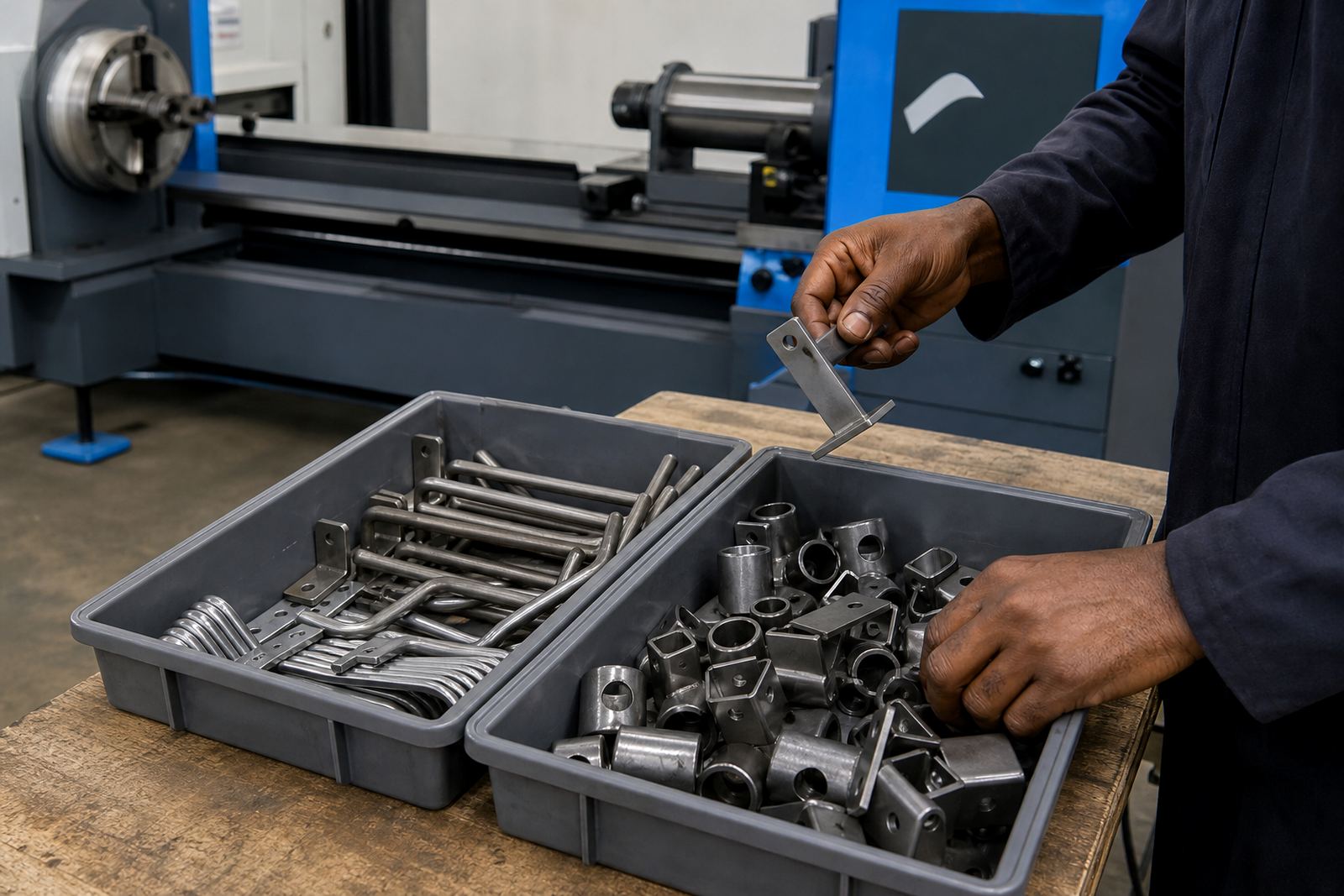
Retail fixture work often looks small on paper, but the parts have to match across many locations. Display frames, hanging rails, shelf supports, sign brackets, gondola uprights and guard rails all depend on the same hole centres, cut lengths and joint fit every time.
That is where fibre laser tube and profile cutting earns its place. Round tube, square tube, rectangular tube, angle and channel can be cut with repeatable accuracy, so parts for one branch in Johannesburg line up with the next branch in Durban or Cape Town. The result is less hand finishing and fewer parts that drift out of tolerance.
- Consistent part lengths for repeated shopfitting runs
- Clean cut holes for bolts, brackets and locating pins
- Better fit between display frames and welded assemblies
- Less grinding on visible retail fittings
Machine set-ups that suit display and fixture work
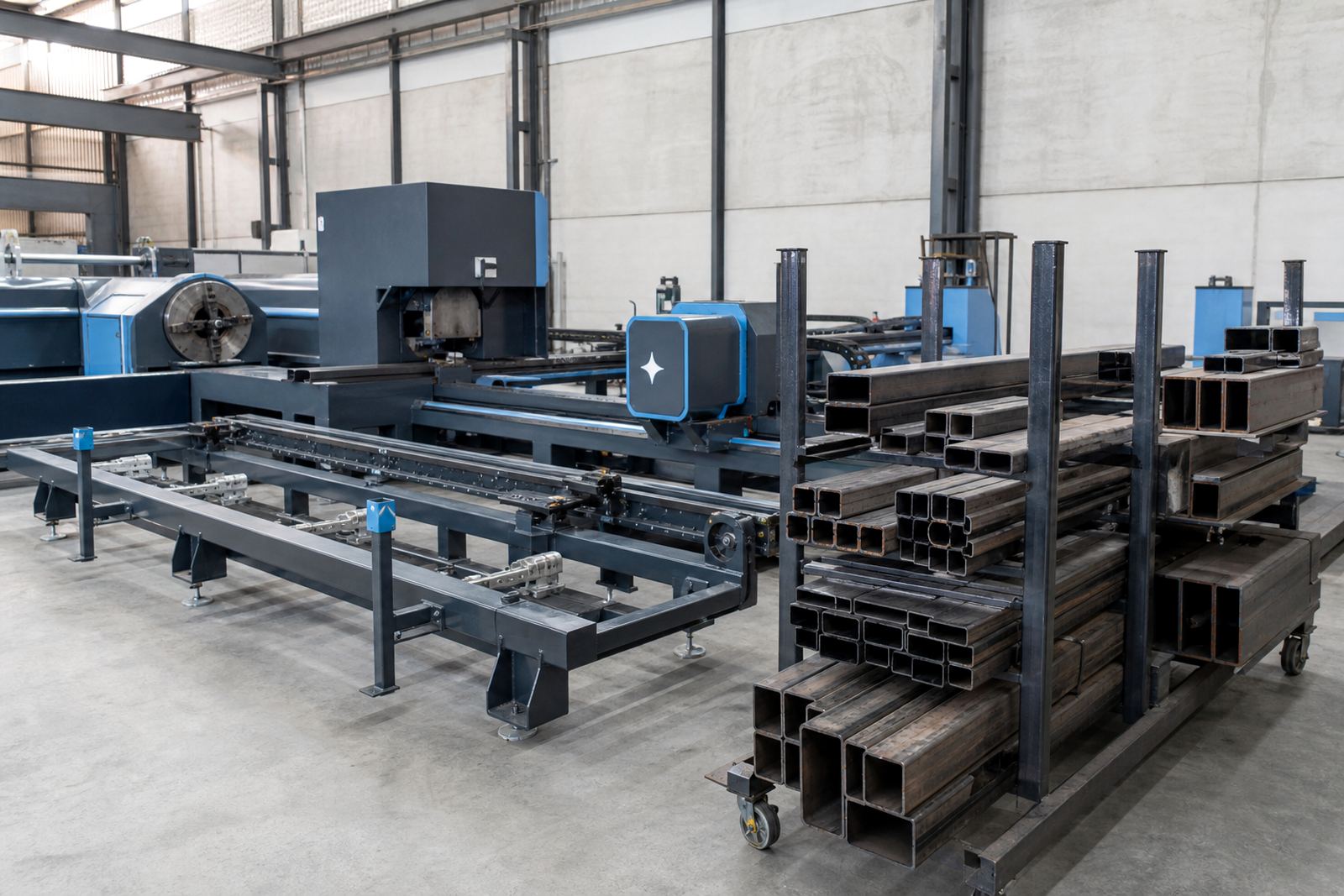
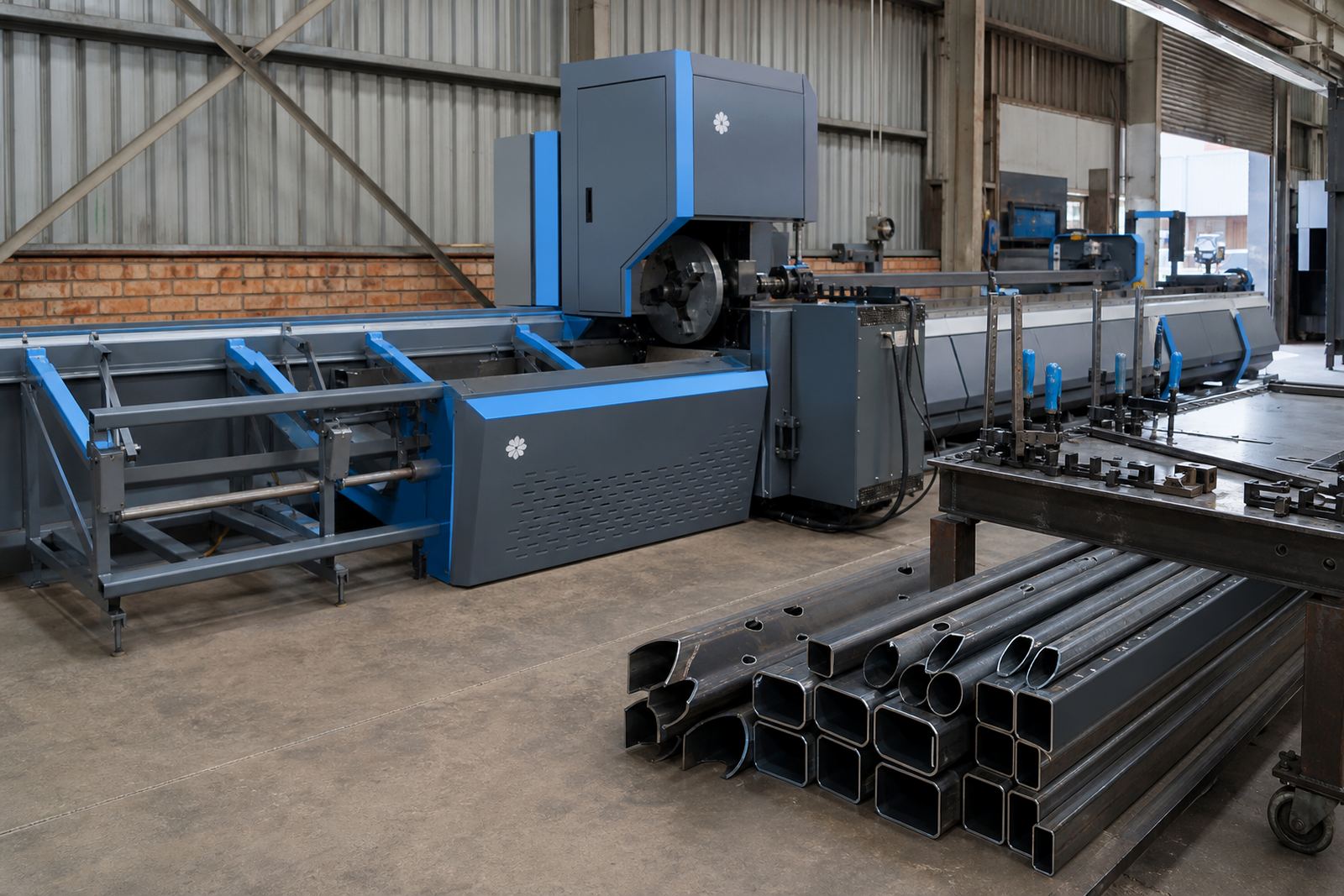
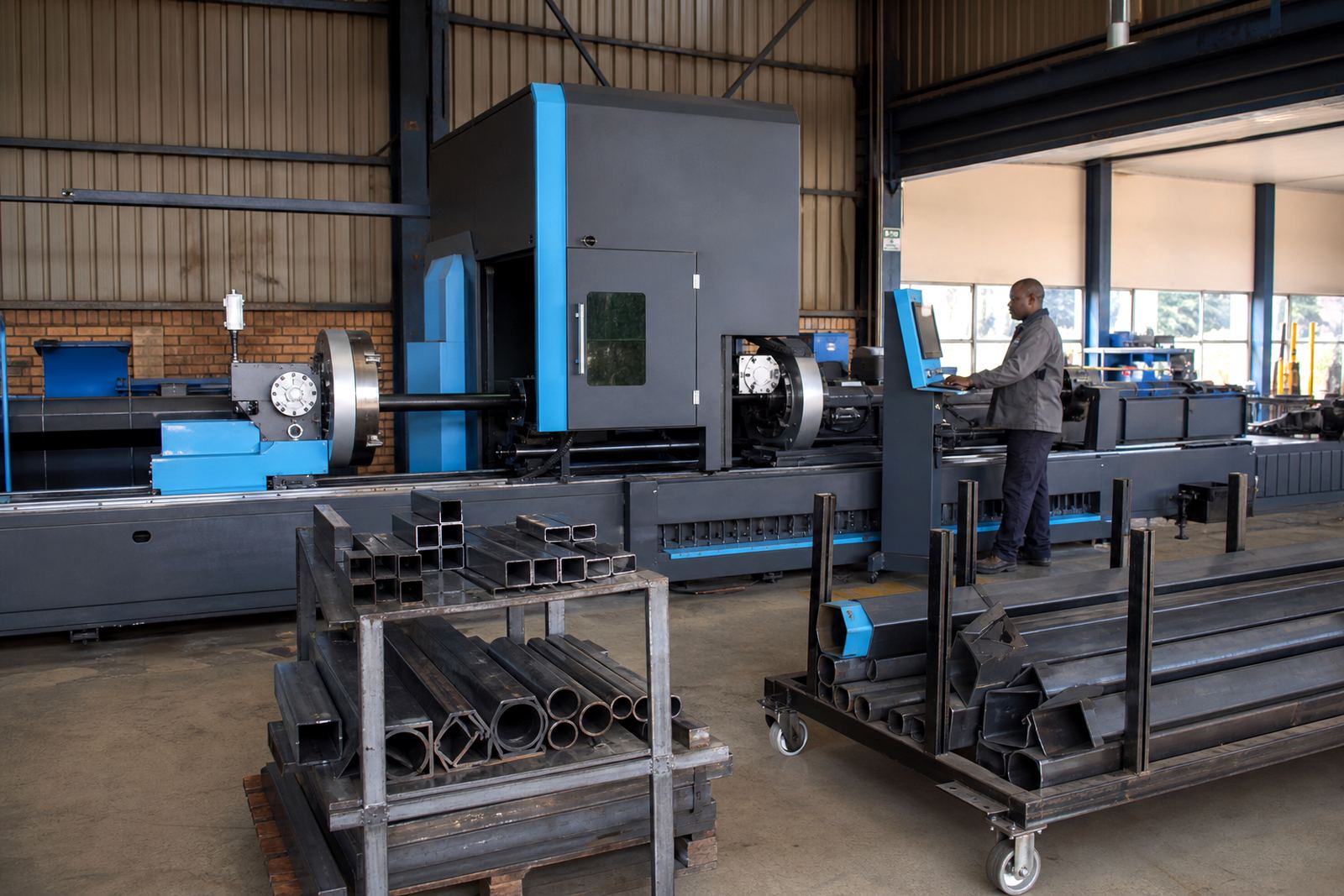
For retail fittings, the usual equipment set is a fibre laser tube machine with automatic loading or a manual loading table, tube chucks for round and shaped material, and nesting software that arranges parts to use tube lengths well. Where the work includes angled joints or decorative frames, a bevel head can help prepare edges for cleaner welds and tighter assembly.
Assist gas matters too. Oxygen, nitrogen or compressed air are used depending on material and finish requirements, and the gas setup needs to suit the steel grade and the edge quality expected on visible retail parts. Safety guarding, extraction and interlocks are part of the installation, especially where operators work near a busy fabrication floor.
- Tube chucks for firm gripping on varied profiles
- Nesting software for batch work and reduced offcuts
- Bevel heads for angled weld prep where needed
- Assist gas setup matched to finish and material type
Planning the floor around batch runs and changeovers
Retail fixture production usually moves between one-off samples and repeat batches. A good layout keeps incoming material, cut parts, inspection and packing close enough to avoid unnecessary handling. If the same machine is cutting parts for several stores, the floor plan should make it easy to stage bundles, label completed sets and separate similar parts that are not interchangeable.
Installation planning is part of the job. LaserTube handles site assessment, delivery rigging, machine installation and commissioning, so the machine lands in a space that works for access, airflow, gas routing and maintenance. In Germiston and Wadeville, many fabrication floors are tight, so the machine position has to respect doorway widths, crane access and the path for raw tube bundles.
Common trouble spots on retail fixture jobs
Retail parts often fail not because the design is wrong but because the process is loose. A few millimetres of drift on one support leg can throw off an entire display run. Tube that is not aligned properly in the chuck can leave inconsistent holes, while weak nesting can waste material across a long batch. If bevel settings are off, weld prep becomes uneven and assembly time rises.
Training helps the floor avoid these problems. Operator training and nesting training are useful when a team is moving from manual cutting or generic profiling into tube work with tighter tolerances. Preventive maintenance, chuck alignment and bevel calibration also keep the machine cutting in the same manner from one production run to the next.
- Incorrect chuck setup leading to hole drift
- Poor nesting that wastes expensive stock lengths
- Weak labelling between similar retail parts
- Skipping preventive maintenance until faults build up
Budget ranges for retail fittings in Rand
Retail fixture work can justify a compact entry machine or a larger production line depending on output. A smaller shop that mainly cuts brackets, frames and short tube sections may look at a lighter setup in the lower millions of Rand, while a plant doing repeated store rollouts may need a higher capacity machine with more automation and stronger material handling.
As a practical guide, budgeting often starts around R1.8 million to R3.5 million for smaller-scale tube cutting set-ups, then moves into roughly R4 million to R8 million where higher throughput, better handling and more advanced tooling are required. Site works, rigging, gas infrastructure and operator training should be carried in the budget too, because the machine alone does not finish the job.
Support across South Africa when retail schedules are tight
LaserTube works from Wadeville, Germiston and supports metal fabricators in Johannesburg, Pretoria, Durban, Cape Town, Gqeberha, Bloemfontein and Nelspruit. For retail fittings, that matters when a chain rollout needs parts cut in one region and installed or commissioned in another. The team includes Michael Dlamini, Anika Kajee, Sibusiso Bhengu, Leanne Mabuza, Pieter Visser and Ayanda Mashaba, covering sales, installation, training, service and applications work.
Breakdown response, remote diagnostics and preventive maintenance are available alongside the installation package. For retail fixture producers, that support helps keep short production windows on track, especially when the same machine is feeding several store launches or fit-out batches across the country.